In recent months, the Fake emails that simulate court notifications.
matters like:
-
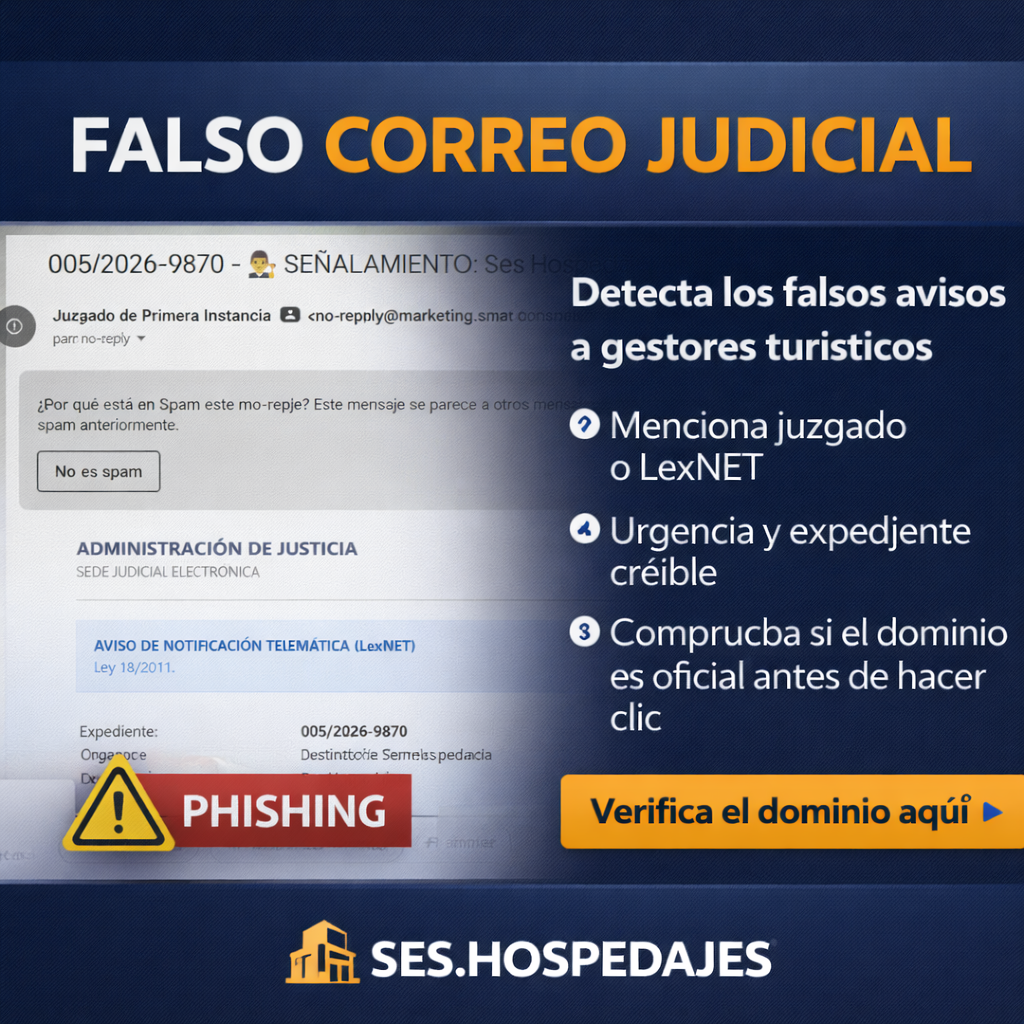
“Signature – Court of First Instance”
-
“Notification via Lexnet”
-
“pending judicial procedure”
They are designed to generate urgency.
But in many cases they are not real.
They are phishing.
If you manage tourist accommodation, vacation homes or rent a car, you are a regular target of this type of attack.
Here we explain how to detect them.
What is a false court mail?
A fake court email is an email that pretends to proceed from:
-
Courts
-
Administration of Justice
-
lexnet
-
Electronic Court Headquarters
But in reality it is sent from private domains for fraudulent purposes.
Its objective is that you click on a malicious link.
The key to detecting judicial phishing: the domain
The most important signal is not in the matter.
It is in the sender's domain.
A real court does not send notifications from:
-
commercial domains
-
Marketing subdomains
-
Generic addresses type @smart…com
Real notifications use institutional domains such as:
-
justice.es
-
mjustice.es
-
Official Autonomous Domains (.gob.es)
If the domain is not institutional, it is a clear signal of alert.
🛠️ New free tool: Judicial Domain Checker
To help you, we have created a free tool.
Enter the sender's domain and check if it belongs to an official institutional domain.
This tool allows you to:
✔ Know if the domain is institutional or private
✔ Detect suspicious subdomains
✔ Quickly check before clicking
It is free and does not require registration.
https://seshospedajes.es/verificador-de-dominios-oficiales-del-ministerio-y-justicia/
How judicial notifications really work in Spain
Official notifications do not arrive as simple HTML emails.
are made through:
-
Lexnet (for professionals)
-
Email address enabled (dehu)
-
Electronic Court Headquarters
Email, if it exists, is just a warning.
You should never access from the email link if you have any doubts.
Enter the official headquarters manually by writing the URL.
5 clear signs that you are facing judicial phishing
-
The dominance of the sender is not institutional.
-
The message generates exaggerated urgency.
-
It does not mention verifiable specific data.
-
Design looks like marketing template.
-
The mail ends in spam.
If you detect two or more, it's probably fraudulent.
Why is the tourism sector a frequent target?
Because he lives in a constant regulation environment:
-
Travellers' Registration
-
Digital Single Window
-
NRUA
-
annual deposit obligations
Phishing takes advantage of that normative pressure.
Where there is mandatory compliance, there is fear of failing to comply.
And where there is fear, there is an impulsive click.
Digital Security and Real Compliance
At SES.Hospedajes we work with real and verifiable legal obligations.
Authentic compliance leaves institutional trace.
Phishing only leaves urgency.
The difference is in the verification.
Protect your activity and your reputation
If you manage tourist accommodation and want:
✔ Correctly comply with the traveler's registration
✔ Automate your official communications
✔ Reduce errors and risks
✔ Operate with regulatory peace of mind
Discover how SES.Hospedajes works:
👉 https://seshospedajes.es/app-seshospedajes/
actual compliance.
No suspicious links.
No improvisation.
No fear.