
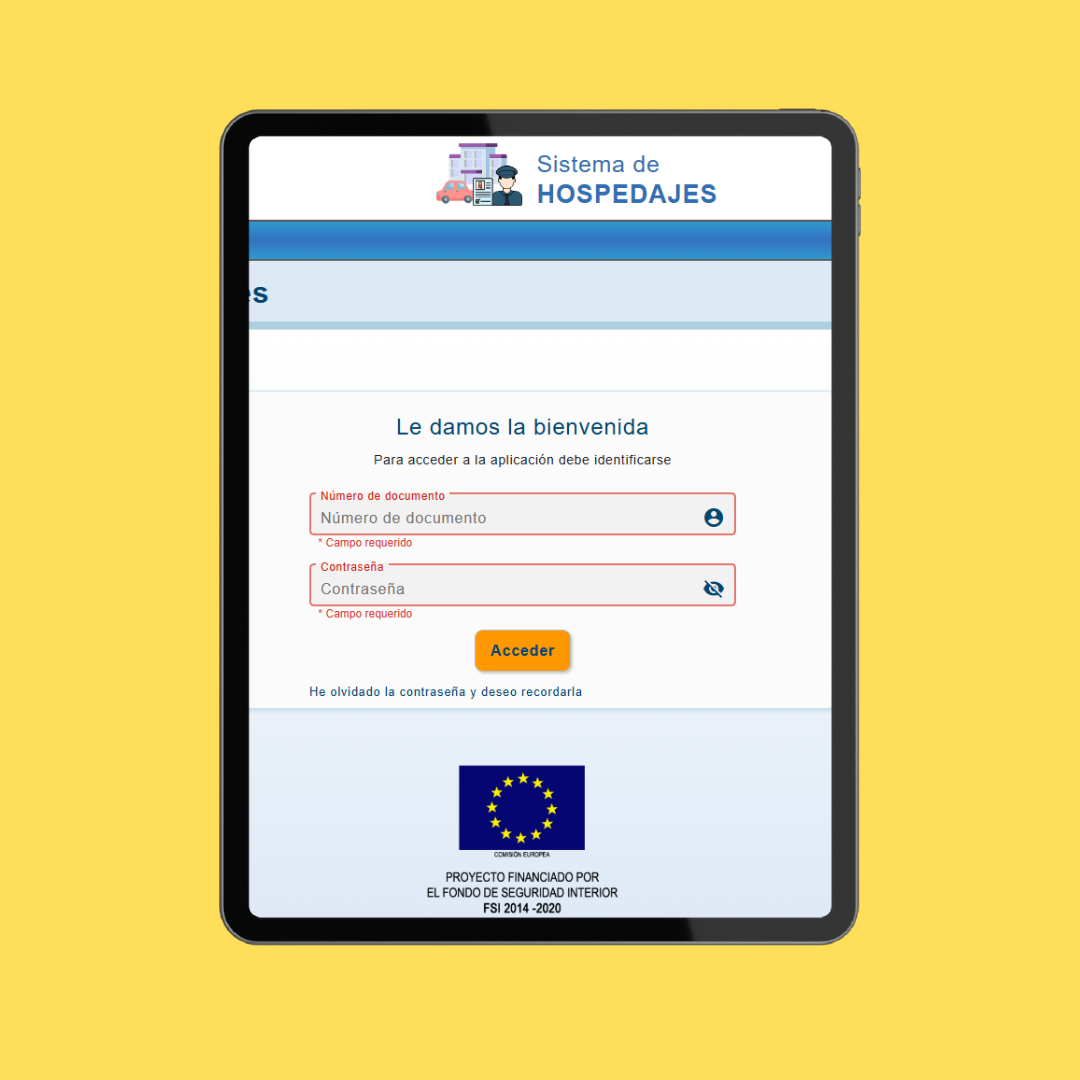
Difference between the user for the web service and the user for the manual entry in the SES.Hospadajes system
The SES.Hospadajes system, managed by the Spanish Ministry of the Interior, provides two main modalities of interaction for the establishments of lodging and rental of vehicles: user for the web service y User for manual data entry. Each is designed for a specific purpose and meets different operational needs. Next, we will explore these differences in detail.
1. User for the web service
This type of user is designed for automatic integrations between the management systems of the companies and the system of the Ministry of the Interior. Here are its main features:
Objective
Automate data communication through web services, which is essential for companies with a large volume of operations.
Features
- API connection: It is done through a web service with HTTPS based security and basic authentication by means of token.
- data format: The data is sent in compressed XML files and encoded in Base64.
- Integration: It allows to integrate the internal system of the company with the service of the Ministry to carry out operations such as:
- Communications registration (parties of travelers, reservations, rentals).
- Consultation of lots and communications.
- Communications cancellation.
- Automated validations: The system automatically checks the data sent and provides real-time feedback using status codes.
- speed and scalability: Ideal for large companies that handle a constant and high flow of data.
Advantage
- Complete automation of the process.
- Reduction of human error.
- faster and more efficient processing.
- Scalability for large volumes of data.
Requirements
- Advanced Technical Configuration: The API client is required to be implemented according to the specification provided by the Ministry.
- Digital certificates and user credentials.
2. User for manual data entry
This type of user is aimed at smaller companies or that do not have the technical resources to integrate an automated system.
Objective
Allow manual data entry directly on the portal of the Ministry of the Interior.
Features
- Web access: Users enter the system through the platform of the electronic headquarters.
- user interface: Designed to facilitate manual data entry through forms.
- Supported operations:
- Registry of traveler parts.
- Consultation and modification of previously registered data.
- Generation manual of reports and consultations.
- Manual validation: Although the system performs some basic validations, the accuracy of the data depends mainly on the user.
Advantage
- It does not require advanced technical knowledge or complex technological infrastructure.
- Ideal for businesses with lower trading volume.
- Low implementation cost.
limitations
- Slower processes due to manual data input.
- higher probability of human error.
- less efficient for mass operations.
final comparison
| Features | Web service user | User Manual Introduction |
|---|---|---|
| Objective | Automation for high volumes. | Manual operations for low volumes. |
| operation mode | API and XML files in base64 format. | Electronic headquarters online form. |
| Technical requirements | Certificates, credentials and development. | Only Internet access and credentials. |
| speed and efficiency | High speed and scalability. | slower and more manual. |
| initial cost | High by technical configuration. | low or non-existent. |
| probability of error | Low (automated validation). | Medium-high (user dependent). |
Conclusion
The choice between both types of users depends on the needs and capabilities of the establishment. Companies with a large volume of operations should opt for web service to maximize efficiency and minimize errors. On the other hand, smaller companies or with limited data volume can benefit from the ease and simplicity of manual data entry.
This duality ensures that the SES.accommodation system is accessible and useful for a wide variety of users, meeting the requirements of the Royal Decree 933/2021 in terms of document registration and data communication.